Introdução ao R para análise de dados em Psicologia
Francisco Pablo Huascar Aragão Pinheiro 

Quem sou eu


- Psicólogo (UFC)
- Mestre em Psicologia (UFC)
- Doutor em educação (UFC)
- Professor do campus Sobral da UFC
- Recentemente, um entusiasta do R
Regressão
Statistical Inference via Data Science: A ModernDive into R and the Tidyverse
Livro base para o aprendizado sobre regressão
Statistical Inference via Data Science: A ModernDive into R and the Tidyverse
- Neste link você pode acessar o livro:
Pacotes utilizados
Obtenção do banco de dados
if(!file.exists("./data")){dir.create("./data")}

df <- read_csv("https://tinyurl.com/contextosm")
Uma olhada no banco de dados
glimpse(df)Rows: 1,000
Columns: 98
$ a1 <dbl> 1, 1, 1, 1, 2, 2, 2, 1, 1, 3, 2, 1, 1, …
$ a2 <dbl> 1, 1, 1, 1, 1, 1, 2, 1, 1, 3, 2, 1, 1, …
$ a3 <dbl> 1, 1, 1, 1, 3, 1, 2, 1, 1, 2, 2, 1, 1, …
$ a4 <dbl> 1, 1, 2, 1, 2, 1, 2, 1, 1, 3, 3, 1, 1, …
$ a5 <dbl> 1, 1, 1, 1, 1, 1, 2, 1, 1, 2, 2, 1, 1, …
$ a6 <dbl> 1, 1, 1, 1, 1, 1, 2, 1, 1, 2, 2, 1, 1, …
$ a7 <dbl> 1, 1, 1, 1, 2, 1, 3, 1, 1, 2, 2, 1, 1, …
$ d1 <dbl> 1, 1, 1, 1, 1, 2, 1, 1, 1, 3, 2, 1, 1, …
$ d2 <dbl> 1, 1, 1, 1, 1, 2, 1, 1, 1, 3, 2, 1, 1, …
$ d3 <dbl> 1, 1, 1, 1, 2, 2, 2, 1, 1, 3, 2, 1, 1, …
$ d4 <dbl> 1, 1, 1, 1, 2, 2, 1, 1, 1, 2, 2, 1, 1, …
$ d5 <dbl> 1, 1, 1, 1, 1, 1, 1, 1, 1, 2, 2, 1, 1, …
$ d6 <dbl> 1, 1, 1, 1, 1, 2, 1, 1, 1, 2, 2, 1, 1, …
$ d7 <dbl> 1, 1, 1, 1, 2, 1, 1, 1, 1, 2, 2, 1, 1, …
$ e1 <dbl> 1, 1, 1, 1, 2, 2, 2, 1, 1, 3, 2, 1, 1, …
$ e2 <dbl> 1, 1, 1, 1, 1, 2, 1, 1, 1, 3, 2, 1, 1, …
$ e3 <dbl> 1, 1, 1, 1, 2, 2, 2, 1, 1, 2, 2, 1, 1, …
$ e4 <dbl> 1, 1, 2, 1, 3, 2, 2, 1, 1, 3, 2, 1, 1, …
$ e5 <dbl> 1, 1, 2, 1, 3, 2, 2, 1, 1, 2, 2, 1, 2, …
$ e6 <dbl> 1, 1, 1, 1, 1, 2, 1, 1, 1, 2, 2, 1, 1, …
$ e7 <dbl> 1, 1, 1, 1, 2, 2, 3, 1, 1, 2, 2, 1, 1, …
$ ct1 <dbl> 1, 1, 3, 3, 4, 4, 4, 3, 4, 3, 3, 1, 3, …
$ ct2 <dbl> 1, 1, 3, 1, 1, 4, 3, 2, 3, 4, 1, 1, 4, …
$ ct3 <dbl> 1, 1, 2, 1, 4, 4, 3, 1, 1, 1, 4, 1, 1, …
$ ct4 <dbl> 1, 1, 3, 3, 4, 2, 4, 3, 4, 3, 1, 1, 5, …
$ ct5 <dbl> 1, 1, 2, 5, 1, 3, 3, 3, 1, 4, 4, 1, 3, …
$ ct6 <dbl> 1, 1, 2, 1, 1, 2, 3, 2, 1, 2, 3, 1, 1, …
$ ct7 <dbl> 1, 1, 3, 3, 4, 4, 4, 3, 3, 3, 4, 1, 3, …
$ ct8 <dbl> 1, 1, 3, 3, 3, 4, 4, 3, 3, 1, 2, 4, 2, …
$ ct9 <dbl> 1, 1, 2, 3, 2, 3, 3, 2, 3, 2, 5, 1, 1, …
$ ct10 <dbl> 1, 1, 2, 1, 1, 3, 3, 3, 3, 4, 2, 1, 2, …
$ ct11 <dbl> 1, 1, 2, 5, 1, 2, 3, 2, 1, 4, 3, 2, 3, …
$ ct12 <dbl> 1, 1, 4, 5, 3, 5, 5, 3, 4, 4, 5, 5, 3, …
$ ct13 <dbl> 1, 1, 2, 5, 2, 5, 4, 3, 2, 4, 3, 5, 3, …
$ ct14 <dbl> 1, 1, 3, 3, 2, 5, 4, 3, 3, 4, 5, 4, 4, …
$ ct15 <dbl> 1, 1, 2, 3, 1, 2, 3, 2, 1, 3, 3, 3, 3, …
$ ct16 <dbl> 1, 1, 3, 3, 2, 4, 3, 3, 2, 3, 5, 1, 2, …
$ ct17 <dbl> 1, 1, 3, 3, 2, 3, 3, 2, 1, 1, 5, 5, 2, …
$ ct18 <dbl> 1, 1, 3, 2, 3, 3, 5, 3, 4, 4, 3, 5, 1, …
$ ct19 <dbl> 1, 1, 3, 3, 2, 3, 4, 3, 3, 1, 5, 1, 3, …
$ ct20 <dbl> 1, 1, 3, 3, 3, 3, 4, 3, 2, 1, 5, 2, 3, …
$ ct21 <dbl> 1, 1, 3, 3, 3, 3, 3, 2, 2, 1, 3, 3, 3, …
$ ct22 <dbl> 1, 1, 2, 3, 4, 3, 3, 3, 1, 3, 3, 1, 3, …
$ ct23 <dbl> 1, 1, 3, 1, 3, 3, 4, 3, 3, 2, 5, 1, 3, …
$ ct24 <dbl> 1, 1, 3, 5, 1, 3, 3, 2, 1, 1, 3, 3, 3, …
$ ct25 <dbl> 1, 1, 2, 1, 3, 3, 2, 3, 2, 4, 3, 3, 2, …
$ ct26 <dbl> 1, 1, 3, 3, 4, 3, 4, 3, 2, 4, 5, 3, 1, …
$ ct27 <dbl> 1, 1, 3, 1, 1, 4, 3, 3, 1, 1, 5, 1, 4, …
$ ct28 <dbl> 1, 1, 2, 3, 1, 4, 3, 3, 3, 2, 3, 1, 1, …
$ ct29 <dbl> 1, 1, 2, 1, 2, 3, 3, 3, 3, 3, 3, 3, 1, …
$ ct30 <dbl> 1, 1, 2, 1, 1, 5, 3, 5, 2, 1, 5, 2, 4, …
$ ct31 <dbl> 1, 1, 1, 1, 1, 2, 1, 2, 1, 5, 3, 1, 1, …
$ ct32 <dbl> 1, 1, 2, 1, 1, 2, 2, 1, 1, 1, 3, 2, 2, …
$ ct33 <dbl> 1, 1, 2, 1, 1, 3, 3, 3, 1, 1, 3, 2, 1, …
$ ct34 <dbl> 1, 1, 3, 3, 2, 4, 3, 2, 2, 1, 3, 5, 1, …
$ ct35 <dbl> 1, 1, 3, 1, 1, 2, 2, 4, 1, 5, 3, 2, 1, …
$ ct36 <dbl> 1, 1, 2, 1, 1, 3, 4, 4, 2, 2, 3, 1, 2, …
$ ct37 <dbl> 1, 1, 2, 1, 1, 5, 3, 3, 1, 3, 3, 4, 3, …
$ ct38 <dbl> 1, 1, 2, 3, 2, 3, 4, 3, 3, 5, 5, 2, 2, …
$ ct39 <dbl> 1, 1, 2, 1, 1, 3, 2, 1, 1, 5, 3, 2, 3, …
$ ct40 <dbl> 1, 1, 4, 1, 2, 3, 3, 3, 4, 5, 5, 5, 1, …
$ srq1 <dbl> 0, 0, 0, 0, 0, 1, 1, 0, 0, 1, 1, 0, 1, …
$ srq2 <dbl> 0, 0, 0, 0, 0, 1, 0, 0, 0, 1, 1, 0, 0, …
$ srq3 <dbl> 0, 0, 0, 0, 1, 1, 1, 0, 0, 1, 1, 0, 1, …
$ srq4 <dbl> 0, 0, 0, 0, 0, 1, 1, 0, 1, 1, 1, 0, 0, …
$ srq5 <dbl> 0, 0, 0, 0, 0, 0, 1, 0, 0, 1, 0, 0, 0, …
$ srq6 <dbl> 0, 1, 1, 0, 1, 1, 1, 0, 0, 1, 1, 0, 0, …
$ srq7 <dbl> 0, 0, 0, 0, 1, 1, 0, 0, 0, 1, 1, 0, 0, …
$ srq8 <dbl> 0, 0, 0, 1, 1, 1, 0, 0, 0, 1, 0, 0, 0, …
$ srq9 <dbl> 0, 0, 0, 0, 1, 1, 1, 0, 0, 1, 1, 0, 0, …
$ srq10 <dbl> 0, 0, 0, 0, 0, 1, 1, 0, 0, 1, 1, 0, 0, …
$ srq11 <dbl> 0, 0, 0, 0, 0, 1, 0, 0, 0, 1, 1, 0, 0, …
$ srq12 <dbl> 0, 1, 0, 0, 0, 1, 1, 0, 0, 1, 1, 0, 0, …
$ srq13 <dbl> 0, 0, 0, 0, 1, 1, 0, 0, 0, 1, 0, 0, 0, …
$ srq14 <dbl> 0, 0, 0, 0, 0, 1, 0, 0, 0, 1, 0, 0, 0, …
$ srq15 <dbl> 0, 0, 0, 0, 0, 1, 0, 0, 0, 1, 0, 0, 0, …
$ srq16 <dbl> 0, 0, 0, 0, 0, 0, 0, 0, 0, 1, 0, 0, 0, …
$ srq17 <dbl> 0, 0, 0, 0, 0, 0, 0, 0, 0, 1, 0, 0, 0, …
$ srq18 <dbl> 0, 0, 0, 0, 0, 1, 1, 0, 0, 1, 0, 0, 0, …
$ srq19 <dbl> 0, 0, 0, 0, 1, 1, 1, 0, 0, 1, 1, 0, 0, …
$ srq20 <dbl> 0, 0, 0, 0, 1, 1, 1, 0, 0, 1, 1, 0, 0, …
$ genero <chr> "Feminino", "Feminino", "Feminino", "Fe…
$ idade <dbl> 37, 46, 44, 46, 46, 36, 41, 61, 37, 25,…
$ cor_raca <chr> "Pardo", "Pardo", "Pardo", "Pardo", "Pa…
$ escolaridade <chr> "Especialização", "Especialização", "Es…
$ estado_civil <chr> "Casado(a)", "Solteiro(a)", "Divorciado…
$ filhos <dbl> 2, 1, 2, 2, 0, 0, 1, 2, 1, 0, 2, 0, 0, …
$ renda_familiar_mensal <dbl> 4000, 4000, 4000, 3500, 6600, 4000, 300…
$ dependentes_da_renda_familar <dbl> 4, 3, 2, 3, 3, 5, 2, 1, 3, 7, 3, 1, 2, …
$ renda_pos_pandemia <chr> "Aumentou", "Diminuiu", "Ficou estável"…
$ estado <chr> "Tocantins", "Ceará", "Pernambuco", "Ce…
$ regiao <chr> "Norte", "Nordeste", "Nordeste", "Norde…
$ grupo_de_risco <chr> "Não", "Sim", "Não", "Sim", "Não", "Não…
$ diag_covid <chr> "Não", "Não", "Não", "Não", "Não", "Sim…
$ perda_covid <chr> "Sim", "Sim", "Não", "Não", "Sim", "Sim…
$ tempo_experiencia_rede_publica <dbl> 6, 18, 25, 24, 11, 12, 5, 34, 5, 3, 5, …
$ tipo_contrato <chr> "Efetivo/Concursado", "Efetivo/Concursa…
$ niveis_de_ensino <chr> "Ensino Fundamental 1", "Atua em mais d…Variáveis Compostas: Saúde Mental
Variáveis Compostas: Saúde Mental
Código
df |>
  select(tmcs:est)
# A tibble: 1,000 × 4
tmcs ans dep est
<dbl> <dbl> <dbl> <dbl>
1 0 7 7 7
2 2 7 7 7
3 1 8 7 9
4 1 7 7 7
5 8 12 10 14
6 17 8 12 14
7 11 15 8 13
8 0 7 7 7
9 1 7 7 7
10 20 17 17 17
# ℹ 990 more rowsVariáveis Compostas: Contexto de Trabalho
Variáveis Compostas: Contexto de Trabalho
Código
df |>
  select(org:rel)
# A tibble: 1,000 × 3
org cond rel
<dbl> <dbl> <dbl>
1 1 1 1
2 1 1 1
3 2.8 2.5 2.2
4 3 2.38 2
5 2.6 2.25 1.1
6 3.8 3.12 2.6
7 3.67 3.75 2.7
8 2.93 3 2.4
9 2.47 2.38 1.4
10 2.33 2.75 3.2
# ℹ 990 more rowsUsos da Regressão
Examinar o efeito de diferentes variáveis (preditoras / independentes) em uma única variável de resultado (dependente)
O uso o termo predição é essencial, pois a análise examina se uma variável prediz (explica ou repercute) outra variável
Simulação da Linha de Regressão
# A tibble: 5 × 2
      x     y
  <dbl> <dbl>
1     0     2
2     1     4
3     2     6
4     3     8
5     4    10
A Linha de Regressão
reg_line |>
  ggplot(aes(x,y)) +
  geom_smooth(
    method = "lm",
    se = F,
    color = "blue"
    ) +
  geom_point(
    color = "red",
    size = 3
    ) +
  theme_classic()
A Linha de Regressão
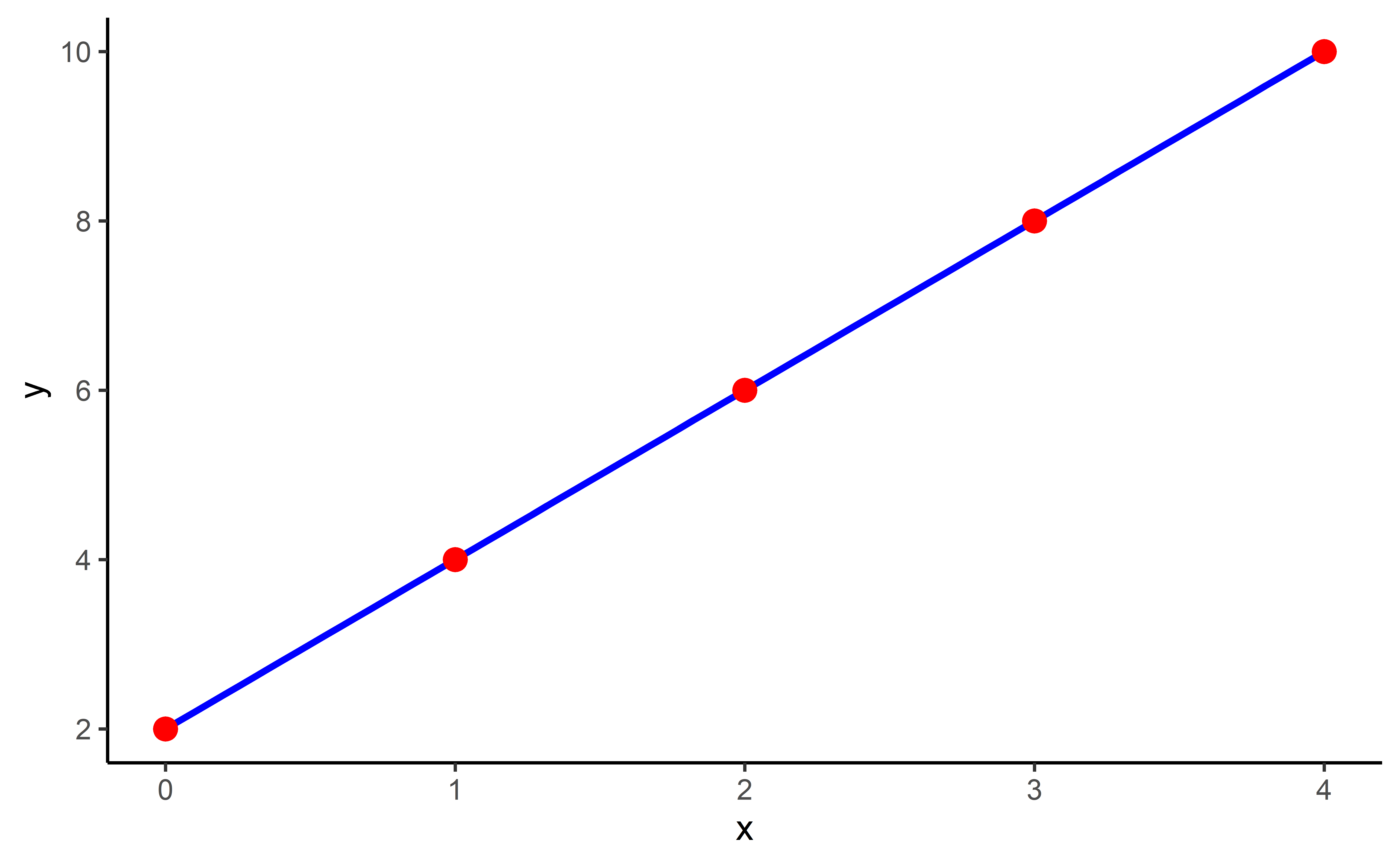
A linha de regressão
\[ y = a + bx \]
- y = VI
- x = VD
- a = constante (local onde a linha intercepta o eixo y, ou seja, onde x = 0)
- b = inclinação da linha (cada vez que “x” aumenta 1 unidade, “y” aumenta “b” unidades)
A Linha de Regressão
reg_line# A tibble: 5 × 2
x y
<dbl> <dbl>
1 0 2
2 1 4
3 2 6
4 3 8
5 4 10- a = 2
- b = 2
Regressão Linear Simples
- Correlação
- Magnitude e direção
- Regressão
- Descobrir o tamanho do efeito de uma variável x (independente, previsora ou explicativa) em uma variável y (dependente, critério ou desfecho)
- Questões
- Quanto a pontuação em TMCs pode variar em função da organização do trabalho?
- Quanto a pontuação em TMCs pode variar em função do pertencimento ao grupo de risco para covid-19?
Regressão Linear Simples: Uma Variável Independente Contínua
- Quanto a pontuação em TMCs pode variar em função da organização do trabalho?
Análise de Dados Exploratória
- Estatística descritiva
- Mínimo
- Máximo
- Média
- Desvio padrão
- Histogramas
- Correlações
- Bivariadas
- Gráficos de dispersão
Análise de Dados Exploratória: Uma Olhada nos Dados
Código
df |>
  select(org, tmcs) |>
  slice_head(n = 10)
# A tibble: 10 × 2
org tmcs
<dbl> <dbl>
1 1 0
2 1 2
3 2.8 1
4 3 1
5 2.6 8
6 3.8 17
7 3.67 11
8 2.93 0
9 2.47 1
10 2.33 20Análise de Dados Exploratória: Estatísticas Univariadas
Código
df |>
  summarise(
    across(c(tmcs,org),
           list("M" = mean,
                "DP" = sd,
                "MIN" = min,
                "MAX" = max))
    ) |>
  pivot_longer(
    cols = everything(),
    names_to = c("Variável", ".value"),
    names_sep = "_"
    )
# A tibble: 2 × 5
Variável M DP MIN MAX
<chr> <dbl> <dbl> <dbl> <dbl>
1 tmcs 4.80 4.94 0 20
2 org 2.95 0.773 1 4.93Análise de Dados Exploratória: Estatísticas Univariadas
df |>
  ggplot(aes(org)) +
  geom_histogram(
    fill = "white",
    color = "gray"
    ) +
  labs(
    y = NULL,
    x = "Organização do Trabalho"
    ) +
  theme_classic()
Análise de Dados Exploratória: Estatísticas Univariadas
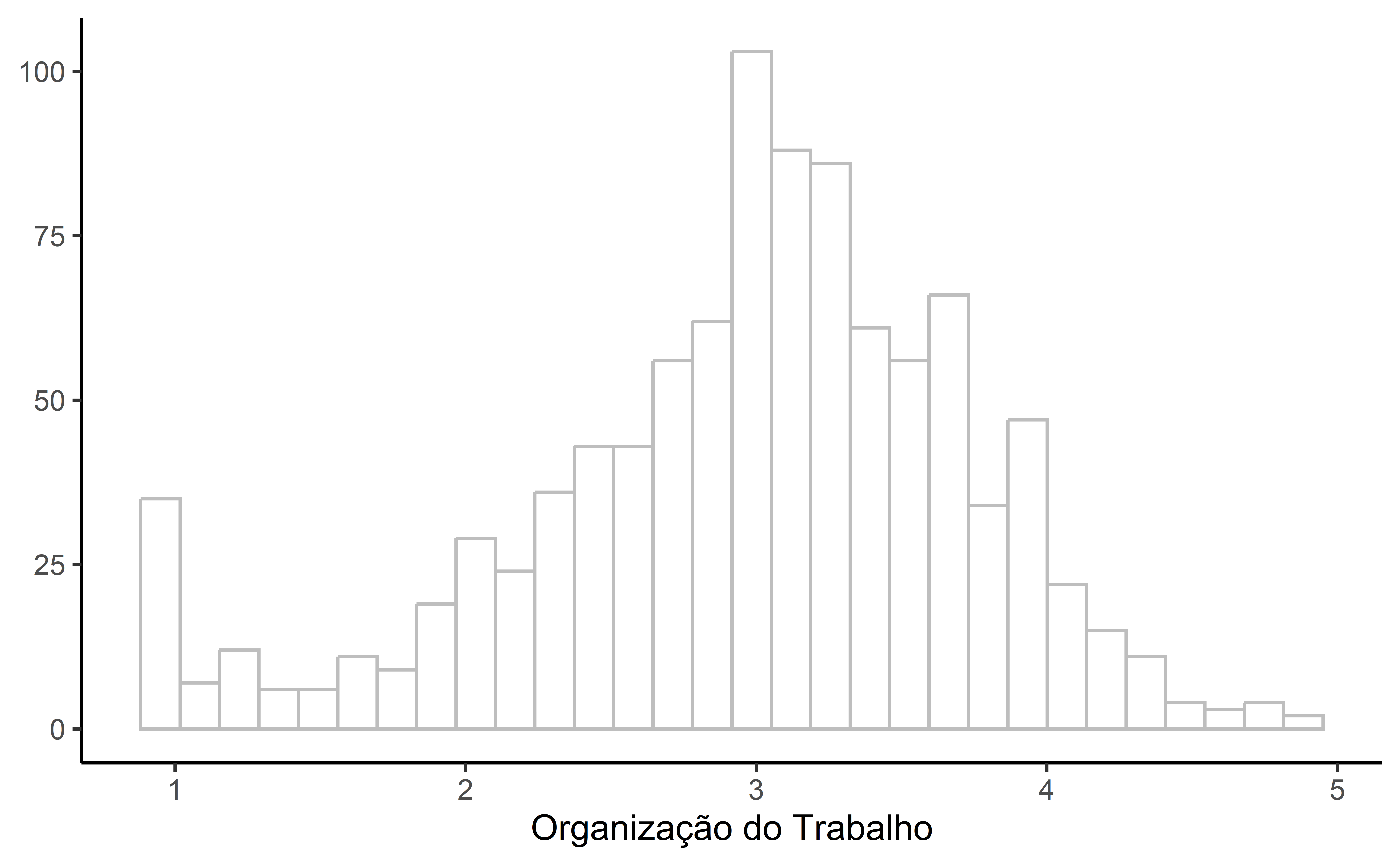
Análise de Dados Exploratória: Estatísticas Univariadas
df |>
  ggplot(aes(tmcs)) +
  geom_histogram(
    fill = "white",
    color = "gray",
    bins = 20
    ) +
  labs(
    y = NULL,
    x = "TMCs"
    ) +
  theme_classic()
Análise de Dados Exploratória: Estatísticas Univariadas
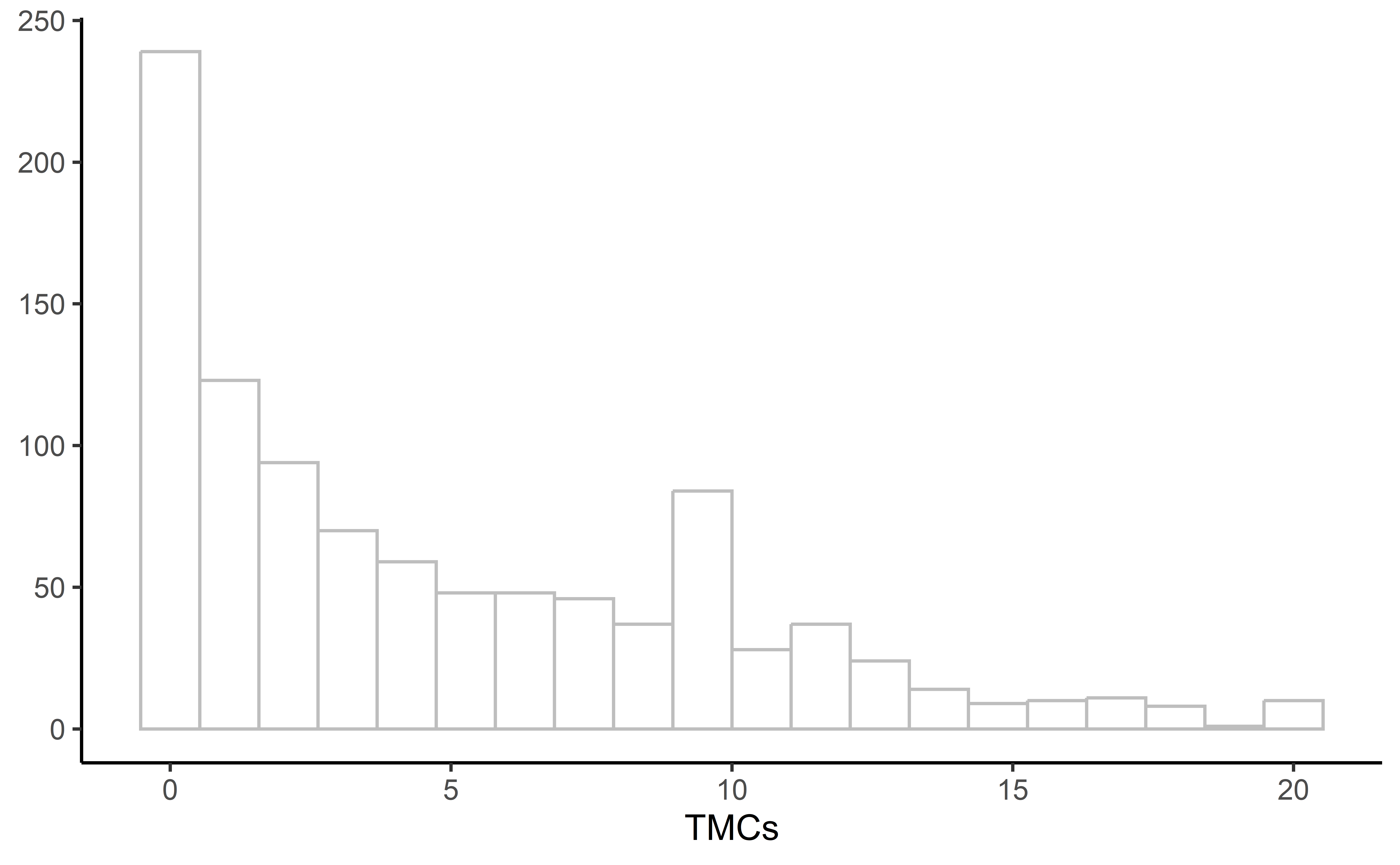
Análise de Dados Exploratória: Estatísticas Bivariadas
- 2 variáveis numéricas
- Coeficiente de Correlação
Análise de Dados Exploratória: Estatísticas Bivariadas
Código
cor.test(df$org,df$tmcs)
    Pearson's product-moment correlation

data:  df$org and df$tmcs
t = 13.436, df = 998, p-value < 2.2e-16
alternative hypothesis: true correlation is not equal to 0
95 percent confidence interval:
 0.3375806 0.4426364
sample estimates:
     cor
0.391383 Análise de Dados Exploratória: Estatísticas Bivariadas
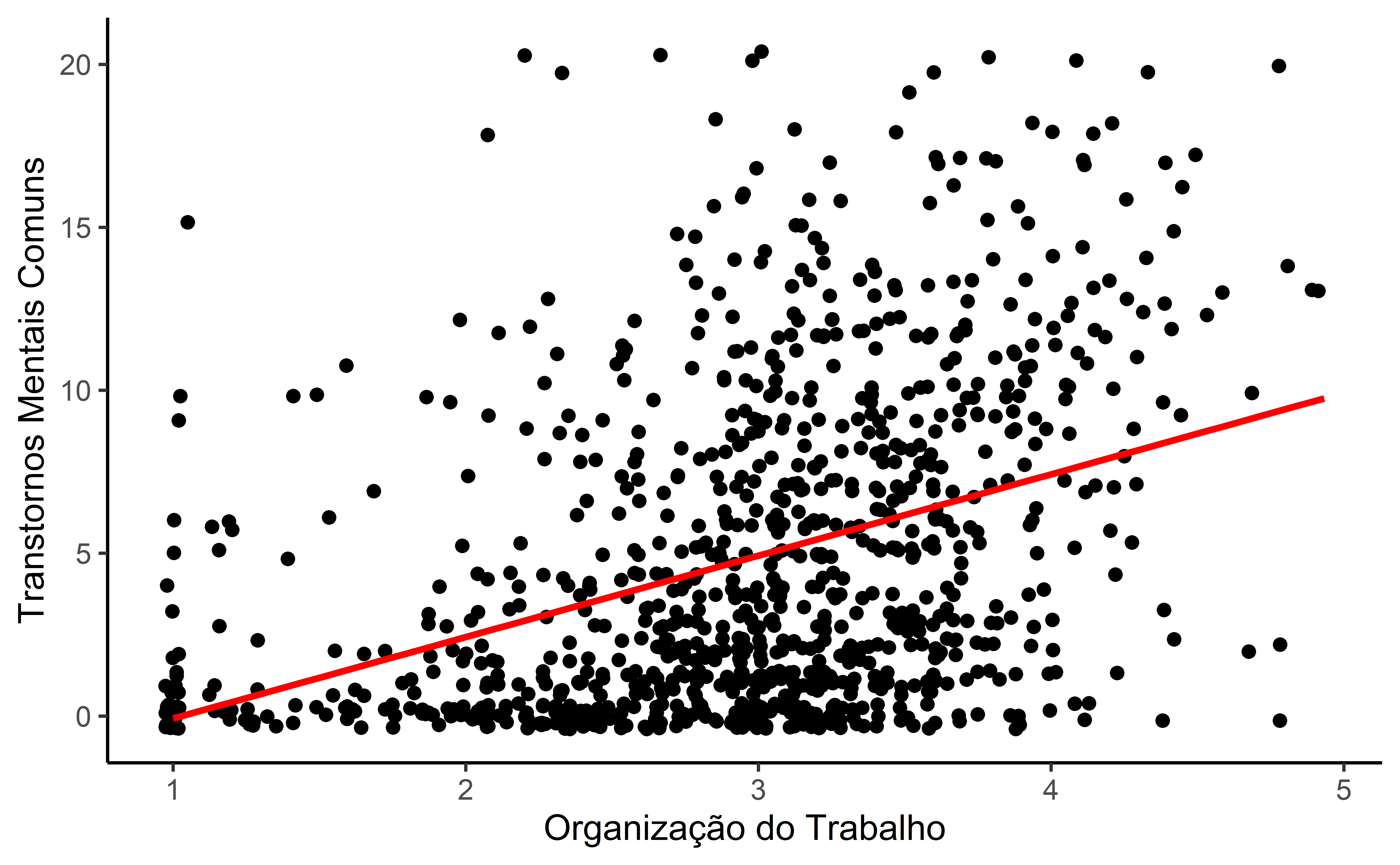
df |>
  ggplot(aes(org,tmcs)) +
  geom_jitter() +
  geom_smooth(
    method = "lm",
    se = F,
    color = "red"
    ) +
  labs(
    x = "Organização do Trabalho",
    y = "Transtornos Mentais Comuns"
    ) +
  theme_classic()
Análise de Dados Exploratória: Estatísticas Bivariadas
Regressão Linear Simples
\[ y = a + bx \]
- A partir do gráfico e do teste de correlação de pearson, o que sabemos até agora sobre entre TMCs e a organização do trabalho? O que podemos dizer sobre a nossa equação?
- b tem uma inclinação positiva!
- Pessoas com piores avaliações da organização do trabalho (escores mais altos) tendem a ter piores índices nos TMCs (pontuações maiores)
Regressão Linear Simples
\[ y = a + bx \]
- Qual o valor numérico para a incliação (slope) b?
- E o valor do intercepto a?
- Vamos utilizar a regressão linear simples para obter essas respostas
Regressão Linear Simples
Notação da regressão:
“~”
VD ~ VI1 + VI2 + VIn
fit_cont <- lm(tmcs ~ org, data = df) Sumário da saída
Código
summary(fit_cont)
Call:
lm(formula = tmcs ~ org, data = df)

Residuals:
    Min      1Q  Median      3Q     Max
-9.4166 -3.4224 -0.9221  2.7411 17.0763

Coefficients:
            Estimate Std. Error t value Pr(>|t|)
(Intercept)  -2.5703     0.5673  -4.531 6.58e-06 ***
org           2.4973     0.1859  13.436  < 2e-16 ***
---
Signif. codes:  0 '***' 0.001 '**' 0.01 '*' 0.05 '.' 0.1 ' ' 1

Residual standard error: 4.544 on 998 degrees of freedom
Multiple R-squared:  0.1532,    Adjusted R-squared:  0.1523
F-statistic: 180.5 on 1 and 998 DF,  p-value: < 2.2e-16
Tabela de Regressão
Tabela de Regressão
Interpretando a Tabela de Regressão
Código
tabela_de_regressao# A tibble: 2 × 5
Preditor Estimativas `Erro-padrão` t p
<chr> <dbl> <dbl> <dbl> <chr>
1 (Intercept) -2.57 0.57 -4.53 < .001
2 org 2.5 0.19 13.4 < .001\[ y = a + bx \]
- Estimativas
- a = Estimativa do Intercepto = -2.57
- b = Estimativa da
org= 2.50
\[ tmcs = -2.57 + 2.50org \]
Interpretando a Tabela de Regressão
Código
tabela_de_regressao# A tibble: 2 × 5
Preditor Estimativas `Erro-padrão` t p
<chr> <dbl> <dbl> <dbl> <chr>
1 (Intercept) -2.57 0.57 -4.53 < .001
2 org 2.5 0.19 13.4 < .001\[ tmcs = -2.57 + 2.50org \]
- Quais conclusões podemos tirar dessa equação?
- O sinal de b é positivo, portanto há uma relação positiva entre as variáveis
- Quanto maior a pontuação em
orgmaior a pontuação emtmcs - Ou seja: piores avaliações da organização do trabalho estão associados a maiores prejuízos a saúde mental
- Quanto maior a pontuação em
- Interpretação do valor de b (estimativa de
org):- Para cada aumento de 1 unidade em
org, há um aumento associado de, em média, 2.50 unidades detmcs
- Para cada aumento de 1 unidade em
- O sinal de b é positivo, portanto há uma relação positiva entre as variáveis
Interpretando a Tabela de Regressão
Código
cor_org_tmcs <- cor.test(df$org,df$tmcs)

cor_org_tmcs
    Pearson's product-moment correlation

data:  df$org and df$tmcs
t = 13.436, df = 998, p-value < 2.2e-16
alternative hypothesis: true correlation is not equal to 0
95 percent confidence interval:
 0.3375806 0.4426364
sample estimates:
     cor
0.391383
Código
r <- cor_org_tmcs$estimate

r^2 |>
  round(4)
cor
0.1532 Código
summary(fit_cont)
Call:
lm(formula = tmcs ~ org, data = df)

Residuals:
    Min      1Q  Median      3Q     Max
-9.4166 -3.4224 -0.9221  2.7411 17.0763

Coefficients:
            Estimate Std. Error t value Pr(>|t|)
(Intercept)  -2.5703     0.5673  -4.531 6.58e-06 ***
org           2.4973     0.1859  13.436  < 2e-16 ***
---
Signif. codes:  0 '***' 0.001 '**' 0.01 '*' 0.05 '.' 0.1 ' ' 1

Residual standard error: 4.544 on 998 degrees of freedom
Multiple R-squared:  0.1532,    Adjusted R-squared:  0.1523
F-statistic: 180.5 on 1 and 998 DF,  p-value: < 2.2e-16
Valores Observados/Ajustados e os Resíduos
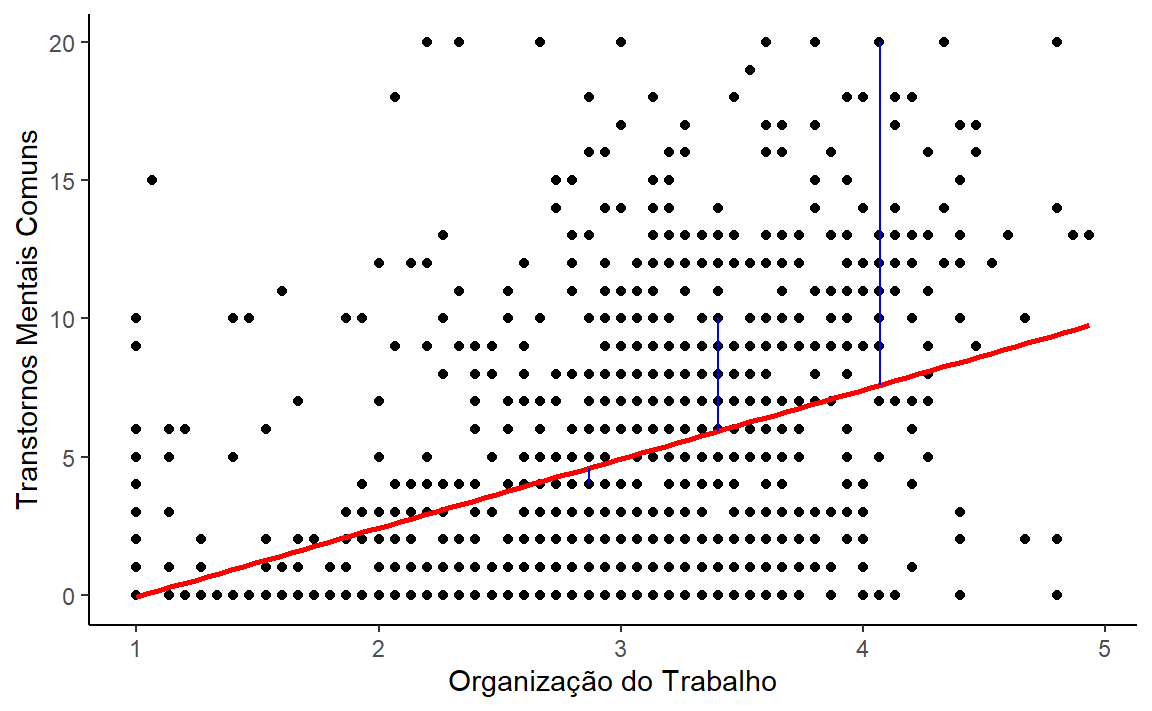
\[ tmcs = -2.57 + 2.50org \]
# A tibble: 1 × 3
     id  tmcs   org
  <int> <dbl> <dbl>
1 15 4 2.87- Valor observado dos tmcs = 4
\[ tmcs = -2.57 + 2.50*2.867 = 4.598 \]
- Valor ajustado/previsto = 4.598
- Resíduos: a diferença entre o que foi ajustado/previsto e o valor observado
\[ resíduo = 4 - 4.598 = -0.598 \]
Valores Observados/Ajustados e os Resíduos
df |>
  ggplot(aes(org,tmcs)) +
  geom_point() +
  geom_smooth(
    method = "lm",
    se = F,
    color = "red"
    ) +
  labs(
    x = "Organização do Trabalho",
    y = "Transtornos Mentais Comuns"
    ) +
  theme_classic()+
  geom_segment(aes(x = 2.867, y = 4,
                   xend = 2.867, yend = 4.598),
               color = "blue")+
  geom_segment(aes(x = 4.07, y = 20,
                   xend = 4.07, yend = 7.59),
               color = "blue") +
  geom_segment(aes(x = 3.4, y = 10,
                   xend = 3.4, yend = 5.92),
               color = "blue")
Valores Observados/Ajustados e os Resíduos
Valores Observados/Ajustados e os Resíduos
Valores Observados/Ajustados e os Resíduos
# A tibble: 15 × 5
      id  tmcs   org .fitted .resid
   <int> <dbl> <dbl>   <dbl>  <dbl>
 1     1     0  1     -0.073  0.073
 2     2     2  1     -0.073  2.07
 3     3     1  2.8    4.42  -3.42
 4     4     1  3      4.92  -3.92
 5     5     8  2.6    3.92   4.08
 6     6    17  3.8    6.92  10.1
 7     7    11  3.67   6.59   4.41
 8     8     0  2.93   4.76  -4.76
 9     9     1  2.47   3.59  -2.59
10    10    20  2.33   3.26  16.7
11    11    12  3.67   6.59   5.41
12    12     0  2.73   4.26  -4.26
13    13     2  3.13   5.26  -3.26
14    14     3  3.67   6.59  -3.59
15    15     4  2.87   4.59  -0.589
Regressão Linear Simples: Uma Variável Independente Categórica
Quanto a pontuação em TMCs pode variar em função do pertencimento ao grupo de risco para covid-19?
Análise de Dados Exploratória
- Estatística descritiva
- Variável Dependente (contínua)
- Mínimo
- Máximo
- Média
- Desvio padrão
- Variável independente (categórica)
- Tabela de frequência
- Gráficos para comparação entre médias/medianas
- Boxplot
- Tabelas para compração entre grupos
- Teste T para amostras independentes (VI dicotômica)
- Variável Dependente (contínua)
Análise de Dados Exploratória: Uma Olhada nos Dados
Código
df |>
  select(tmcs, grupo_de_risco) |>
  slice_head(n = 10)
# A tibble: 10 × 2
tmcs grupo_de_risco
<dbl> <chr>
1 0 Não
2 2 Sim
3 1 Não
4 1 Sim
5 8 Não
6 17 Não
7 11 Não
8 0 Sim
9 1 Não
10 20 Não Análise de Dados Exploratória: Estatísticas Univariadas
Código
df |>
  summarise(
    across(c(tmcs),
           list("M" = mean,
                "DP" = sd,
                "MIN" = min,
                "MAX" = max))
    ) |>
  pivot_longer(
    cols = everything(),
    names_to = c("Variável", ".value"),
    names_sep = "_"
    )
# A tibble: 1 × 5
Variável M DP MIN MAX
<chr> <dbl> <dbl> <dbl> <dbl>
1 tmcs 4.80 4.94 0 20Análise de Dados Exploratória: Estatísticas Univariadas
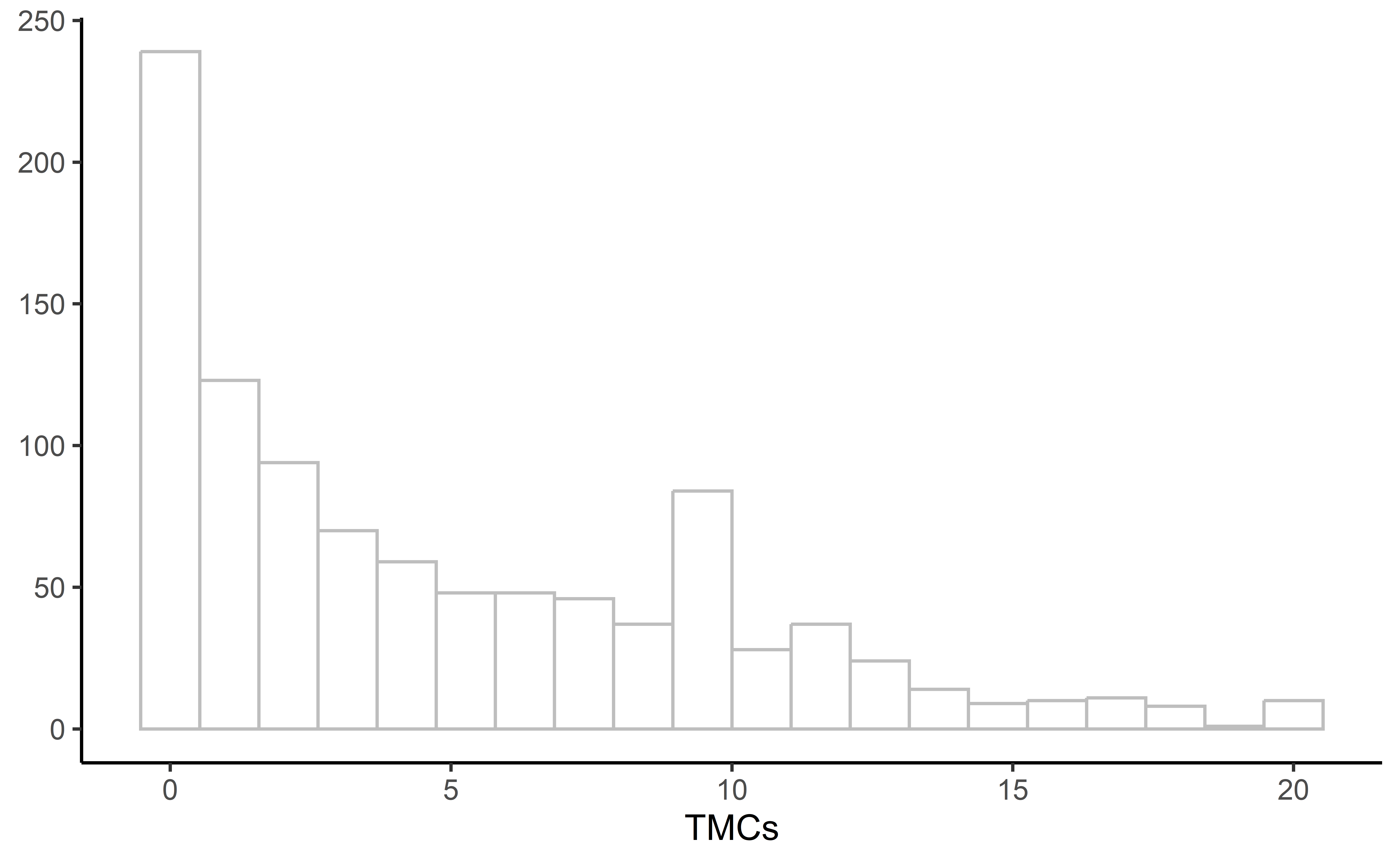
df |>
  ggplot(aes(tmcs)) +
  geom_histogram(
    fill = "white",
    color = "gray",
    bins = 20
    ) +
  labs(
    y = NULL,
    x = "TMCs"
    ) +
  theme_classic()
Análise de Dados Exploratória: Estatísticas Univariadas
Análise de Dados Exploratória: Tabelas de Frequência
Comparação entre Grupos
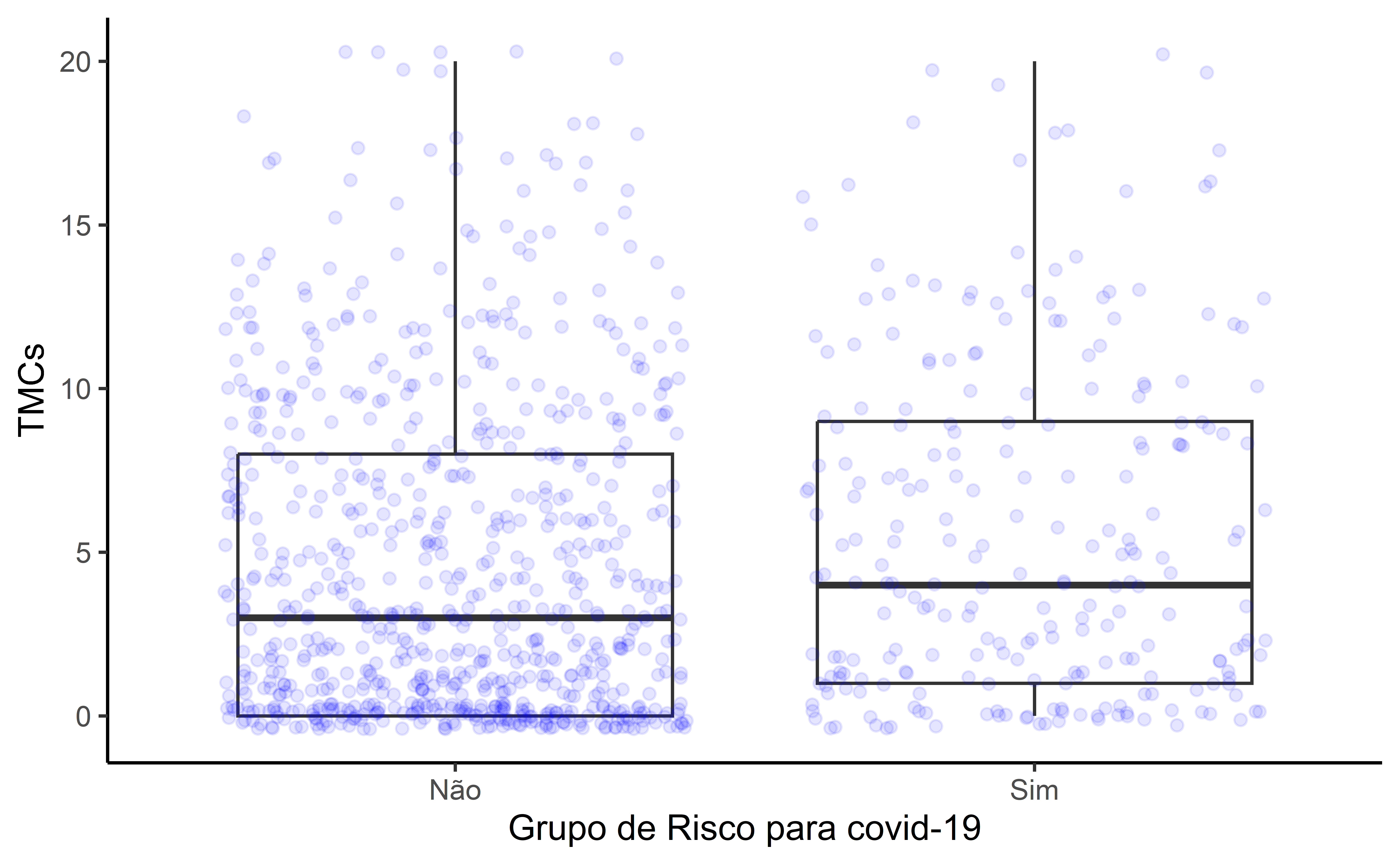
df |>
  ggplot(aes(grupo_de_risco,tmcs))+
  geom_boxplot() +
  geom_jitter(aes(grupo_de_risco),
              alpha = 0.1,
              size = 1.5,
              color = "blue") +
  labs(
    x = "Grupo de Risco para covid-19",
    y = "TMCs"
    ) +
  theme_classic()
Comparação entre Grupos
Resultados entre Grupos
Diferenças Entre as Médias
Diferenças Entre as Médias
Código
t.test(tmcs ~ fct_relevel(grupo_de_risco, "Sim"), data = df,var.equal = T)
    Two Sample t-test

data:  tmcs by fct_relevel(grupo_de_risco, "Sim")
t = 3.0395, df = 998, p-value = 0.002431
alternative hypothesis: true difference in means between group Sim and group Não is not equal to 0
95 percent confidence interval:
 0.3887405 1.8051091
sample estimates:
mean in group Sim mean in group Não
         5.630081          4.533156
Regressão Linear Simples
fit_cat <- lm(tmcs ~ grupo_de_risco, data = df) Sumário da Regressão
Código
summary(fit_cat)
Call:
lm(formula = tmcs ~ grupo_de_risco, data = df)

Residuals:
   Min     1Q Median     3Q    Max
-5.630 -4.533 -1.533  3.370 15.467

Coefficients:
                  Estimate Std. Error t value Pr(>|t|)
(Intercept)         4.5332     0.1790   25.33  < 2e-16 ***
grupo_de_riscoSim   1.0969     0.3609    3.04  0.00243 **
---
Signif. codes:  0 '***' 0.001 '**' 0.01 '*' 0.05 '.' 0.1 ' ' 1

Residual standard error: 4.915 on 998 degrees of freedom
Multiple R-squared:  0.009172,  Adjusted R-squared:  0.00818
F-statistic: 9.239 on 1 and 998 DF,  p-value: 0.002431
Tabela de Regressão
Interpretando a Tabela de Regressão
Código
tabela_de_regressao_cat# A tibble: 2 × 5
Preditor Estimativas `Erro-padrão` t p
<chr> <dbl> <dbl> <dbl> <chr>
1 (Intercept) 4.53 0.18 25.3 < .001
2 grupo_de_riscoSim 1.1 0.36 3.04 < .001- Estimativa do Intercepto = média do grupo_de_riscoNão = 4.53
- Estimativa do grupo_de_riscoSim = diferença entre a média do grupo_de_riscoNao e a média grupo_de_riscoSim = 1.10
Código
dif# A tibble: 2 × 3
grupo_de_risco M DIF
<chr> <dbl> <dbl>
1 Não 4.53 0
2 Sim 5.63 1.10